In modern
Artificial Intelligence and
Machine Learning, one of the most powerful techniques for working with images, videos, and visual data is the
Convolutional Neural Network (CNN).
CNN is a type of deep learning model specially designed to process data that has a grid-like structure, such as images.
CNNs are widely used in face recognition, medical imaging, self-driving cars, object detection, and many other real-world applications.
What is CNN?
A Convolutional Neural Network (CNN) is a type of Neural Network that automatically learns important features from images without needing manual feature engineering.
In traditional machine learning, we had to manually create features, but CNN can learn features by itself using multiple layers.
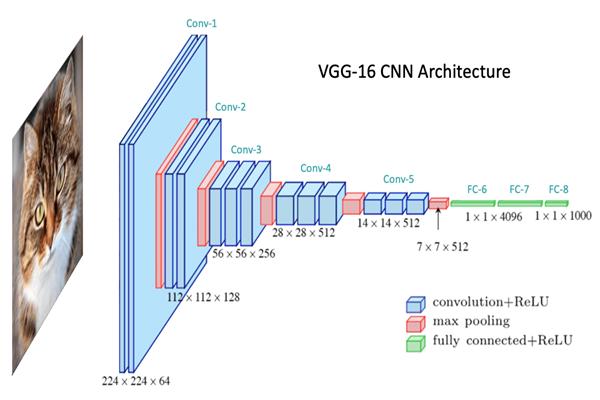
Example:
- Input → Image
Output → Cat / Dog
CNN automatically learns:
- Edges
- Shapes
- Patterns
- Objects
This makes CNN very powerful for image-related tasks.
Why CNN is Needed
Normal neural networks do not work well with images because:
- Images have too many pixels
- Too many parameters cause overfitting
- Training becomes slow
CNN solves these problems by using:
- Convolution layers
- Feature maps
- Pooling
- Shared weights
Because of this, CNN is the main model used in Deep Learning.
Basic Structure of CNN
A CNN usually contains these layers:
- Convolution Layer
- Activation Function
- Pooling Layer
- Fully Connected Layer
- Output Layer
Let’s understand each step.
1. Convolution Layer
This is the most important part of CNN. The convolution layer uses a small filter (kernel) that moves across the image to detect patterns.
Example patterns:
- Edges
- Corners
- Lines
- Shapes
This operation is called Convolution.
Example:
Input Image → Filter → Feature MapThe result is called a feature map.
CNN learns which filters are useful during training.
2. Activation Function
After convolution, we apply an activation function to add non-linearity.
Most common activation:
- ReLU (Rectified Linear Unit)
Formula:
ReLU(x) = max(0, x)Why needed?
- Helps model learn complex patterns
- Makes training faster
3. Pooling Layer
Pooling reduces the size of the image while keeping important information.
Common type:
- Max Pooling
Example:
4x4 image → 2x2 imageBenefits:
- Reduces computation
- Prevents overfitting
- Keeps important features
- Pooling makes CNN efficient.
4. Fully Connected Layer
After convolution and pooling, the data is flattened and sent to a fully connected layer.
This layer works like a normal neural network.
Example:
Features → Fully Connected → PredictionThis layer decides the final result.
Example:
- Cat
- Dog
- Car
- Human
5. Output Layer
The output layer gives the final prediction.
For classification, we often use:
Softmax
Softmax converts values into probabilities.
Example:
Cat = 0.8
Dog = 0.1
Car = 0.1
Final prediction = Cat
How CNN Learns
CNN learns using training data and a process called Backpropagation.
Steps:
- Input image
- Prediction
- Compare with actual result
- Calculate error
- Update weights
- Repeat many times
After many iterations, the CNN becomes accurate.
Real-World Applications of CNN
CNN is used in many industries.
Image Recognition
- Face detection
- Photo tagging
- Security systems
Medical AI
- Tumor detection
- X-ray analysis
- MRI scanning
Self Driving Cars
- Detect road
- Detect people
- Detect traffic signs
Video Analysis
- Object tracking
- Motion detection
NLP (with images)
- OCR
- Handwriting recognition
- CNN made computer vision possible in modern AI.
Famous CNN Models
Some popular CNN architectures:
- LeNet
- AlexNet
- VGG16
- ResNet
- YOLO
These models improved image recognition accuracy a lot.
Advantages of CNN
- Automatic feature learning
- High accuracy for images
- Less manual work
- Works well with large data
- Used in real-world AI systems
Limitations of CNN
- Needs large data
- Requires GPU for training
- Hard to understand internally
- Training takes time
- Still, CNN is the best model for image-related tasks.
Conclusion
Convolutional Neural Network (CNN) is one of the most important models in modern AI and machine learning. It allows computers to understand images by automatically learning features using convolution, pooling, and deep layers.
Because of its power and accuracy, CNN is widely used in computer vision, healthcare, robotics, and self-driving cars, making it one of the foundations of modern artificial intelligence systems.
