A Neural Network is a core concept in Artificial Intelligence (AI) and Machine Learning that is inspired by how the human brain works. Just like our brain has billions of neurons connected to process information, a neural network consists of interconnected nodes that learn patterns from data.
Today, neural networks power technologies like voice assistants, image recognition, chatbots, recommendation systems, and self-driving cars.
What is a Neural Network?
A Neural Network is a computational model made up of layers of artificial neurons that process data and learn from it.
In simple words:
It is a system that learns from examples instead of being explicitly programmed.
For example:
- Recognizing spam emails
- Identifying faces in photos
- Predicting stock prices
Structure of a Neural Network
A neural network typically has 3 main types of layers:
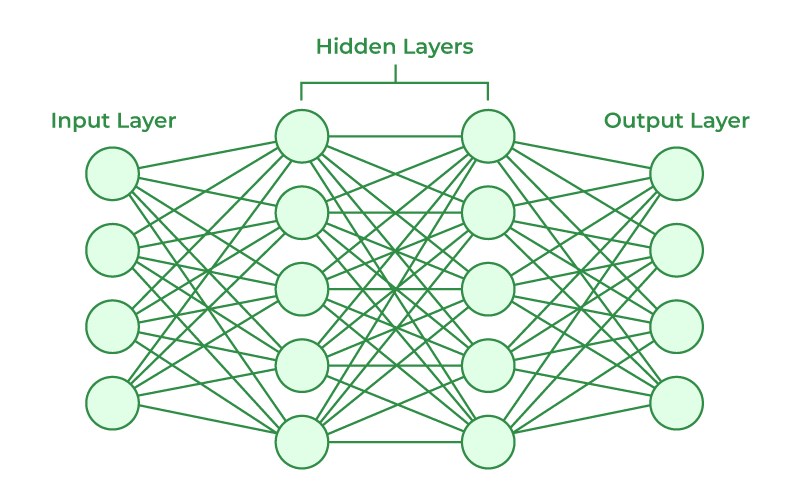
Input Layer
- Receives raw data
- Example: image pixels, text features, numbers
Hidden Layers
- Perform calculations and feature extraction
- Can be one or many layers (Deep Learning = many hidden layers)
Output Layer
- Produces final result
- Example: Yes/No, Class label, Probability score
How Neural Networks Work
Step-by-Step Process
- Input Data is fed into the network
- Each neuron multiplies inputs by weights
- Adds bias and applies an activation function
- Output passes to next layer
- Final prediction is generated
- Error is calculated
- Weights are updated using Backpropagation
This process repeats until the network learns correctly.
Key Components
Weights
- Control importance of input features
Bias
- Helps adjust output
Activation Function
- Decides whether a neuron should activate
- Common activation functions:
- ReLU
- Sigmoid
- Tanh
Types of Neural Networks
Feedforward Neural Network
- Basic type
- Data moves in one direction
Convolutional Neural Network (CNN)
- Used for images and videos
- Detects patterns like edges, shapes
Recurrent Neural Network (RNN)
- Used for sequential data
- Example: speech recognition, text prediction
Deep Neural Networks (DNN)
- Multiple hidden layers
- Used in advanced AI applications
Real-World Applications
Neural networks are used everywhere:
- Face recognition systems
- Medical diagnosis
- Fraud detection
- Language translation
- Autonomous vehicles
- Chatbots and virtual assistants
Advantages
- Learns complex patterns
- Works well with large data
- High accuracy
- Improves over time
Disadvantages
- Needs large training data
- High computational power
- Hard to interpret (Black box problem)
Neural Network vs Traditional Programming
| Traditional Programming | Neural Network |
|---|---|
| Uses fixed rules | Learns from data |
| Manual logic | Automatic learning |
| Less flexible | Highly adaptive |
Future of Neural Networks
Neural networks are driving the future of AI:
- Human-like conversation systems
- Smart healthcare diagnosis
- Autonomous robotics
- Personalized AI assistants
They are becoming more powerful with advances in Deep Learning and computing power.
Conclusion
Neural Networks are the foundation of modern Artificial Intelligence. They allow machines to learn, adapt, and make intelligent decisions just like humans. As data and technology continue to grow, neural networks will play an even bigger role in shaping the future.
