But does keyword density still matter today? Or is it an outdated SEO myth?
Let’s break it down clearly and practically.
What is Keyword Density?
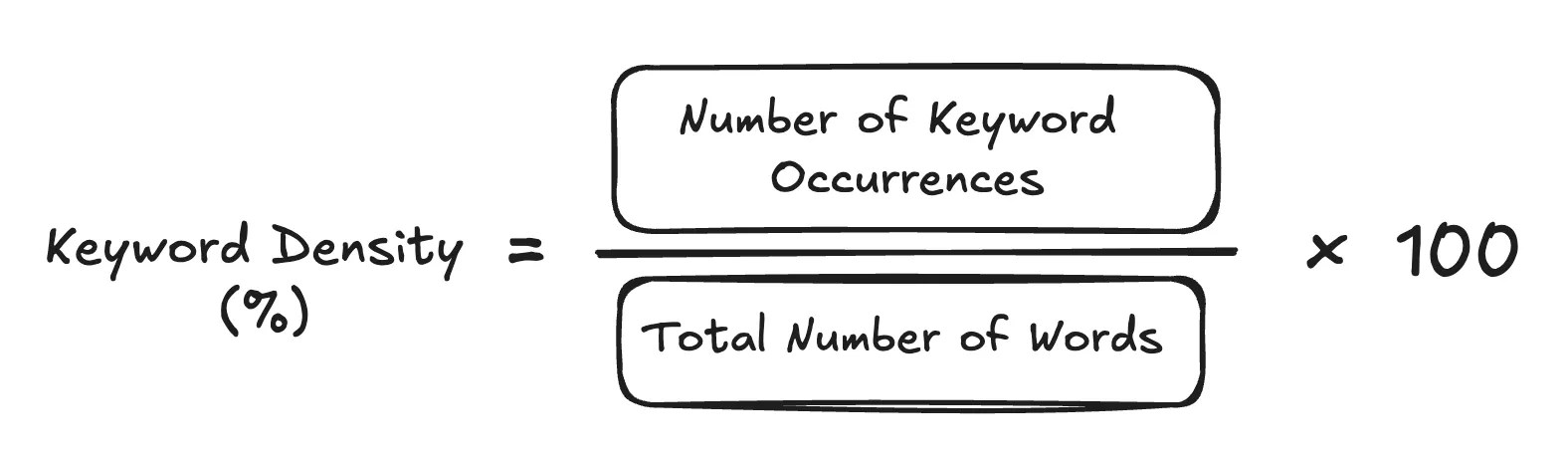
Keyword density refers to the percentage of times a keyword appears in a piece of content compared to the total number of words.
Formula:
Example:
Total words in article: 1000
- Keyword used: 20 times
- Keyword Density = (20 / 1000) × 100 = 2%
- So your keyword density is 2%.
Why Was Keyword Density Important in the Past?
In the early 2000s, search engines relied heavily on keyword frequency to determine what a page was about.
More keyword repetitions = higher relevance = higher rankings.
This led to:
- Keyword stuffing
- Poor readability
- Unnatural content
- Spammy pages ranking higher than helpful content
Example of keyword stuffing :
“Best SEO tools are important because SEO tools help with SEO tools research using SEO tools strategies.”
Clearly unnatural and terrible for users.
Does Keyword Density Still Matter in 2026?
Short Answer:
Not in the way you think.
Modern search engines like Google use:
- Natural Language Processing (NLP)
- Semantic search
- AI-based ranking systems
- User behavior signals
- Search intent analysis
Google no longer counts keywords the way it used to.
Instead, it understands:
- Topic relevance
- Context
- Synonyms
- User intent
- Content depth
So obsessing over hitting “2% keyword density” is outdated.
What Matters More Than Keyword Density?
1. Search Intent
Are you answering what the user actually wants?
If someone searches:
- “What is keyword density?” → They want a definition.
- “Does keyword density matter in SEO?” → They want expert analysis.
Intent > Repetition.
2. Topical Relevance
Instead of repeating one keyword, cover related terms:
For "keyword density", include:
- SEO best practices
- Keyword stuffing
- On-page SEO
- Semantic SEO
- Search algorithms
This builds topical authority.
3. Content Quality
Google evaluates:
- Usefulness
- Readability
- Depth
- Expertise
- Experience
- Trust signals (E-E-A-T)
You can rank with 0.8% density if the content is excellent.
You can fail with 3% density if the content is poor.
4. Natural Language
Modern SEO favors natural writing. If your keyword fits naturally, use it.
If it sounds forced, don’t.
Is There an Ideal Keyword Density?
There is no official ideal percentage.
However, as a general observation:
- 0.5% – 2% is typically natural
- Above 3% may start looking spammy
- Over-optimization can hurt rankings
But remember — this is a guideline, not a rule.
When Keyword Density Still Matters
While it's not a ranking factor in the traditional sense, it still has indirect value:
1. Ensures Topic Clarity
If your keyword appears only once in a 2000-word article, search engines may struggle to understand the main topic.
2. Helps Avoid Under-Optimization
Sometimes writers forget to include the primary keyword naturally.
3. Prevents Keyword Stuffing
Tracking density helps you avoid overuse.
So think of it as a diagnostic metric, not a ranking strategy.
Modern Alternative: Semantic SEO
Instead of focusing on repetition, focus on:
- Entities
- Context
- Related questions
- Internal linking
- Structured headings
- Content clusters
For example, a well-optimized article on keyword density should also discuss:
- Keyword stuffing
- On-page SEO
- TF-IDF
- LSI keywords (conceptually, not outdated use)
- Google algorithms
That signals authority.
Practical SEO Tips (2026 Strategy)
Instead of worrying about density:
- Put your primary keyword in:
- Title
- URL
- Meta description
- H1
- First 100 words
- A few subheadings (if natural)
- Use variations and synonyms.
- Write for humans first.
- Cover the topic comprehensively.
- Avoid robotic repetition.
Final Verdict
Keyword density is not dead, but it is no longer a primary ranking factor.
Think of it like salt in cooking:
- Too little → bland (under-optimized)
- Too much → ruined (keyword stuffing)
- Just enough → natural and effective
The real ranking power today comes from:
- Search intent
- Content quality
- Topical authority
- User engagement
- Trust and expertise
So stop calculating percentages obsessively.
