Object construction gets messy fast. A class with six optional properties either forces you into a constructor with six parameters (most of them
null or default at any given call site) or a pile of property assignments that leave the object in a half-built state until the last line executes. The
Fluent Builder Pattern solves this by giving you a readable, chainable way to construct complex objects step by step — while keeping the object itself immutable and always valid once built.
This post explains what the pattern is, when to reach for it, and walks through a full C# implementation with comments explaining each piece.
What Is the Builder Pattern?
The Builder Pattern is a creational design pattern that separates the construction of a complex object from its representation. Instead of a constructor doing all the work, a separate
Builder class assembles the object piece by piece and returns the finished result only when you ask for it.
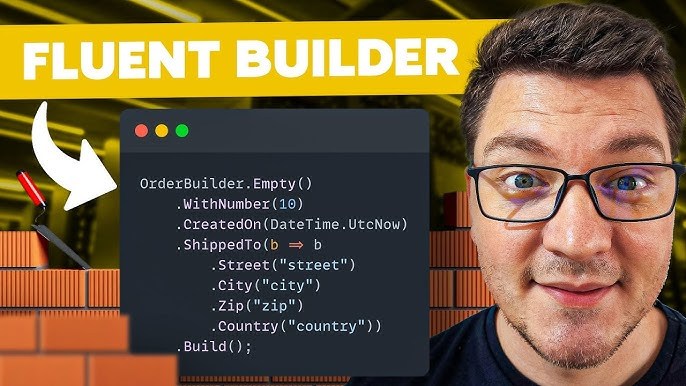
The Fluent part refers to method chaining — each builder method returns the builder itself (this), so calls can be strung together in a single readable expression:
var email = new EmailBuilder()
    .From("noreply@mindstick.com")
    .To("ravi@example.com")
    .WithSubject("Weekly Digest")
    .WithBody("Here's what's new this week...")
    .Build();
Compare that to a traditional constructor call with the same six or seven parameters, half of them
null:
// Hard to read — what does "true, null, false" even mean here?
var email = new Email("noreply@mindstick.com", "ravi@example.com", "Weekly Digest",
    "Here's what's new...", null, true, false);
The fluent version reads almost like a sentence, and it's self-documenting — you don't need to check the constructor signature to know what each value means.
When to Use It
Reach for a fluent builder when:
- An object has many optional parameters and a telescoping set of constructor overloads would be unreadable
- You want the finished object to be immutable — the builder mutates itself during construction, but the final object never changes after
Build() - Construction involves validation or multi-step logic that doesn't belong inside the object's own constructor
- You're building configuration, requests, or query objects — this is exactly why you see this pattern all over .NET itself: HttpRequestMessage, WebApplicationBuilder, LINQ's method chaining, and EF Core's DbContextOptionsBuilder all follow this shape
Don't use it for simple objects with two or three required fields — a constructor is clearer and cheaper to write.
Building It: A Real Example
Let's build a ReportBuilder that constructs a Report object — something close to real reporting/document generation logic you'd write for a dashboard or export feature.
Step 1: The Immutable Target Object
using System;
using System.Collections.Generic;

// The final object we want to construct. Notice every property has only
// a private setter (or none at all) — nothing outside this class, not even
// the builder after Build() runs, can mutate it. That immutability is the
// whole point: once built, a Report can never end up in an inconsistent state.
public class Report
{
    public string Title { get; }
    public string Author { get; }
    public DateTime GeneratedOn { get; }
    public IReadOnlyList<string> Sections { get; }
    public bool IncludeCharts { get; }

    // Constructor is internal-ish by convention — only ReportBuilder is meant
    // to call it. We still keep it public here for simplicity, but in a
    // larger codebase you'd typically make the builder a nested class so it
    // can use a private constructor.
    public Report(string title, string author, DateTime generatedOn,
                  IReadOnlyList<string> sections, bool includeCharts)
    {
        Title = title;
        Author = author;
        GeneratedOn = generatedOn;
        Sections = sections;
        IncludeCharts = includeCharts;
    }

    public override string ToString() =>
        $"\"{Title}\" by {Author} ({Sections.Count} sections, charts: {IncludeCharts})";
}
Step 2: The Fluent Builder
public class ReportBuilder
{
    // These backing fields hold state WHILE the object is being built.
    // They're mutable — that's fine, because they never escape this class
    // until Build() packages them into an immutable Report.
    private string _title = "Untitled Report";
    private string _author = "Unknown";
    private readonly List<string> _sections = new();
    private bool _includeCharts;

    // Each "With..." method sets one piece of state and returns "this".
    // Returning the builder itself is what enables method chaining —
    // without it, every call below would need its own line and variable.
    public ReportBuilder WithTitle(string title)
    {
        if (string.IsNullOrWhiteSpace(title))
            throw new ArgumentException("Title cannot be empty.", nameof(title));

        _title = title;
        return this; // <-- the key to fluent chaining
    }

    public ReportBuilder WithAuthor(string author)
    {
        _author = author;
        return this;
    }

    // AddSection appends rather than replaces, so callers can call it
    // multiple times to build up a list — e.g. .AddSection("Intro").AddSection("Results")
    public ReportBuilder AddSection(string sectionName)
    {
        _sections.Add(sectionName);
        return this;
    }

    // A simple boolean toggle — no argument needed since calling this method
    // at all signals intent. Some fluent APIs use this "presence implies true" style.
    public ReportBuilder WithCharts()
    {
        _includeCharts = true;
        return this;
    }

    // Build() is the terminal method — it does NOT return the builder.
    // This is what ends the chain and hands back a fully-formed, immutable object.
    // Any last-minute validation across multiple fields belongs here.
    public Report Build()
    {
        if (_sections.Count == 0)
            throw new InvalidOperationException("A report must have at least one section.");

        return new Report(
            _title,
            _author,
            DateTime.UtcNow,      // generation timestamp is set only at build time
            _sections.AsReadOnly(),
            _includeCharts);
    }
}
Step 3: Using It
// Reads top to bottom like a sentence: "build a report titled X, by Y,
// with these sections, including charts."
Report report = new ReportBuilder()
    .WithTitle("Q3 Sales Performance")
    .WithAuthor("Ravi Patel")
    .AddSection("Executive Summary")
    .AddSection("Regional Breakdown")
    .AddSection("Forecast")
    .WithCharts()
    .Build();

Console.WriteLine(report);
// Output: "Q3 Sales Performance" by Ravi Patel (3 sections, charts: True)
Notice what you don't have to do: no remembering parameter order, no passing
null or false for things you don't care about, no partially-constructed object floating around before it's ready.
A Common Variation: Fluent + Static Entry Point
Many real-world fluent APIs (like WebApplicationBuilder.CreateBuilder()) start the chain from a static factory method instead of
new. It reads slightly cleaner and hides the constructor entirely:
public class ReportBuilder
{
    // Private constructor forces everyone through the static factory below.
    private ReportBuilder() { }

    // Static entry point — this is the "Create()" convention you'll
    // recognize from ASP.NET Core's WebApplication.CreateBuilder().
    public static ReportBuilder Create() => new ReportBuilder();

    // ...same WithTitle(), WithAuthor(), AddSection(), Build() as before
}
// Chain now starts with Create() instead of new ReportBuilder()
var report = ReportBuilder.Create()
    .WithTitle("Q3 Sales Performance")
    .AddSection("Executive Summary")
    .Build();
This is purely stylistic, but it's worth knowing since you'll see both conventions across the .NET ecosystem.
Key Takeaways
- The builder holds mutable working state; the object it produces is
immutable once
Build()runs. - Every fluent method returns
this— that's the entire mechanism behind method chaining. Forget thereturn this;and the chain breaks with a compiler error. Build()is the one method in the chain that doesn't return the builder — it's your natural place for final validation.- Use it when construction is complex or highly configurable; skip it for simple objects where a constructor is just as readable.
The pattern shows up constantly in .NET's own APIs — once you've built one yourself, you'll start recognizing it everywhere from
StringBuilder to HttpClientBuilder to EF Core's fluent configuration API.
