The SOLID principles are five fundamental design guidelines in object-oriented programming that help you write clean, scalable, and maintainable code.
They were introduced by Robert C. Martin and are widely used in modern software development.
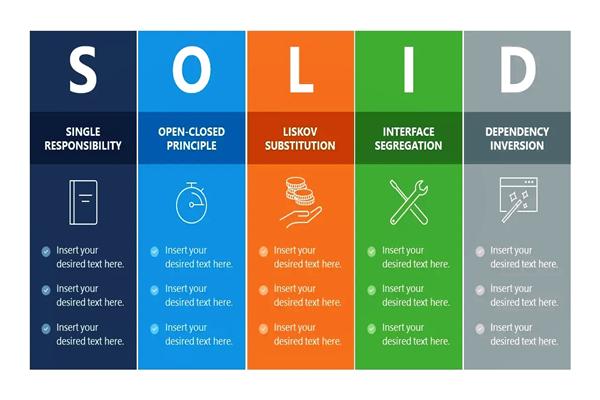
What Does SOLID Stand For?
- S – Single Responsibility Principle
- O – Open/Closed Principle
- L – Liskov Substitution Principle
- I – Interface Segregation Principle
- D – Dependency Inversion Principle
1. Single Responsibility Principle (SRP)
A class should have only one reason to change.
Bad Example
public class Report
{
    public void GenerateReport() { }
    public void SaveToFile() { }
}
Good Example
public class Report
{
    public void GenerateReport() { }
}

public class ReportSaver
{
    public void SaveToFile() { }
}
Benefit: Easier to maintain and test
2. Open/Closed Principle (OCP)
Software should be open for extension, but closed for modification.
Example
public interface IDiscount
{
    double Apply(double amount);
}

public class FestivalDiscount : IDiscount
{
    public double Apply(double amount) => amount * 0.9;
}
You can add new discounts without changing existing code.
3. Liskov Substitution Principle (LSP)
Derived classes should be replaceable with base classes without breaking behavior.
Bad Example
public class Bird
{
    public virtual void Fly() { }
}

public class Ostrich : Bird
{
    public override void Fly()
    {
        throw new Exception("Cannot fly");
    }
}
Problem: Breaks expected behavior
4. Interface Segregation Principle (ISP)
Don’t force a class to implement methods it doesn’t use.
Bad Example
public interface IWorker
{
    void Work();
    void Eat();
}
Good Example
public interface IWork
{
    void Work();
}

public interface IEat
{
    void Eat();
}
5. Dependency Inversion Principle (DIP)
Depend on abstractions, not concrete implementations.
Example
public interface IMessageService
{
    void Send(string message);
}

public class EmailService : IMessageService
{
    public void Send(string message) { }
}

public class Notification
{
    private readonly IMessageService _service;

    public Notification(IMessageService service)
    {
        _service = service;
    }
}
Why SOLID Matters
- Improves code readability
- Makes code easier to test
- Reduces bugs
- Helps in scaling large applications
Real-World Use
In ASP.NET Core / MVC, SOLID helps in:
- Clean architecture
- Dependency injection
- Service-based design
Common Mistakes
- Overengineering small projects
- Ignoring abstraction boundaries
- Misusing interfaces
Final Thoughts
SOLID principles are not just theory—they are practical guidelines that help you write professional, production-level code.
Summary
| Principle | Meaning |
|---|---|
| SRP | One responsibility per class |
| OCP | Extend without modifying |
| LSP | Replaceable inheritance |
| ISP | Small, specific interfaces |
| DIP | Depend on abstractions |
