SQL normalization is a database design technique used to organize data in a structured way to reduce redundancy and improve data integrity. In simple terms, normalization ensures that your database stores data efficiently and avoids duplication, inconsistency, and update anomalies.
Normalization is achieved through a series of rules called normal forms. Each level builds upon the previous one, making the database design cleaner and more reliable.
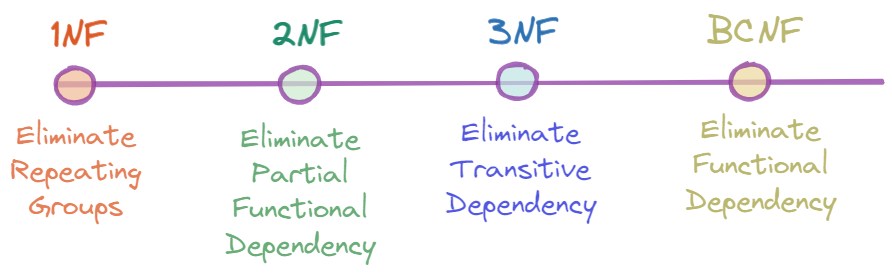
Why Normalization Matters
Without normalization, databases can become messy:
- Duplicate data increases storage and confusion
- Updating data becomes error-prone
- Deleting records may unintentionally remove useful information
Normalization solves these issues by splitting data into related tables and defining relationships between them.
First Normal Form (1NF)
A table is in First Normal Form (1NF) if:
- Each column contains atomic (indivisible) values
- Each record is unique
- No repeating groups or arrays
Example (Not in 1NF)
| StudentID | Subjects |
|---|---|
| 1 | Math, Science |
Converted to 1NF
| StudentID | Subject |
|---|---|
| 1 | Math |
| 1 | Science |
Key Idea: Break multi-valued fields into separate rows.
Second Normal Form (2NF)
A table is in Second Normal Form (2NF) if:
- It is already in 1NF
- All non-key attributes fully depend on the primary key
- This mainly applies to tables with composite keys.
Example (Not in 2NF)
| StudentID | CourseID | StudentName |
|---|
Here, StudentName depends only on StudentID, not the full key.
Solution
Split into:
- Student(StudentID, StudentName)
- Enrollment(StudentID, CourseID)
Key Idea: Remove partial dependencies.
Third Normal Form (3NF)
A table is in Third Normal Form (3NF) if:
- It is in 2NF
- There are no transitive dependencies
- A transitive dependency occurs when a non-key column depends on another non-key column.
Example (Not in 3NF)
| StudentID | DepartmentID | DepartmentName |Here, DepartmentName depends on DepartmentID, not directly on
StudentID.
Solution
- Student(StudentID, DepartmentID)
- Department(DepartmentID, DepartmentName)
Key Idea: Remove indirect dependencies.
Boyce-Codd Normal Form (BCNF)
BCNF is a stricter version of 3NF.
A table is in BCNF if:
- For every functional dependency, the determinant is a candidate key
This handles edge cases where 3NF still allows anomalies.
Fourth Normal Form (4NF)
A table is in Fourth Normal Form (4NF) if:
- It has no multi-valued dependencies
Example
A student can have multiple hobbies and multiple skills independently.
Instead of:
| StudentID | Hobby | Skill |Split into:
- StudentHobby(StudentID, Hobby)
- StudentSkill(StudentID, Skill)
Fifth Normal Form (5NF)
A table is in Fifth Normal Form (5NF) if:
- It removes join dependencies
- Data cannot be further decomposed without losing information
This level is rarely needed in practical applications but is useful in complex systems.
Advantages of Normalization
- Reduces data redundancy
- Improves data consistency
- Makes updates and deletes safer
- Enhances database structure and scalability
Disadvantages of Normalization
- More tables → more joins required
- Can impact performance in read-heavy systems
- Queries may become complex
When to Use Denormalization
In real-world systems, especially high-performance applications, developers sometimes use denormalization (intentionally adding redundancy) to reduce joins and improve speed.
Conclusion
SQL normalization is a foundational concept in database design. Starting from 1NF to 5NF, each step refines your data structure to eliminate redundancy and ensure consistency. While full normalization is ideal in theory, practical applications often balance normalization with performance needs.
A well-designed database is not just normalized—it is optimized for the specific use case.
