In SQL, a function is a predefined or user-defined routine that performs a specific operation and returns a value. Functions help simplify queries, improve reusability, and make data manipulation more efficient.
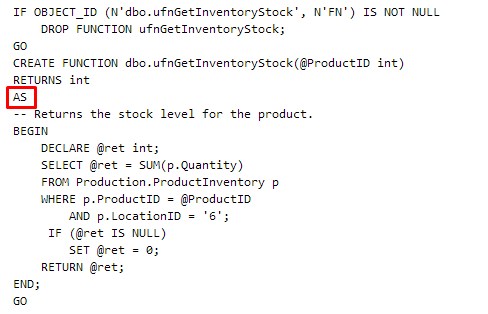
Types of SQL Functions
SQL functions are mainly divided into two categories:
1. Built-in Functions
These are predefined functions provided by SQL.
a) Aggregate Functions
Used to perform calculations on a set of values.
COUNT()– Counts number of rowsSUM()– Calculates totalAVG()– Finds averageMAX()– Finds maximum valueMIN()– Finds minimum value
Example:
SELECT COUNT(*) AS TotalEmployees FROM Employees;
b) Scalar Functions
Operate on a single value and return a single value.
Common Types:
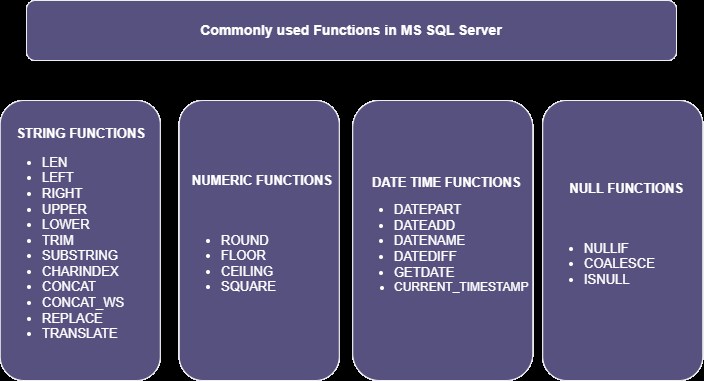
- String Functions:
UPPER(),LOWER(),LEN() - Numeric Functions:
ROUND(),ABS() - Date Functions:
GETDATE(),DATEDIFF()
Example:
SELECT UPPER(Name) FROM Employees;
2. User-Defined Functions (UDFs)
These are custom functions created by users to perform specific tasks.
Types of UDFs:
a) Scalar Functions
Return a single value.
CREATE FUNCTION GetFullName (@FirstName VARCHAR(50), @LastName VARCHAR(50))
RETURNS VARCHAR(100)
AS
BEGIN
    RETURN @FirstName + ' ' + @LastName
END
b) Table-Valued Functions
Return a table instead of a single value.
CREATE FUNCTION GetEmployeesByDept (@DeptId INT)
RETURNS TABLE
AS
RETURN (
    SELECT * FROM Employees WHERE DepartmentId = @DeptId
)
Advantages of SQL Functions
- Reusability of logic
- Cleaner and modular code
- Improves readability
- Reduces duplication
- Helps in complex calculations
Limitations of SQL Functions
- Can affect performance if overused
- Limited error handling compared to stored procedures
- Cannot modify database state (in most cases)
- Restrictions on using dynamic SQL
Function vs Stored Procedure
| Feature | Function | Stored Procedure |
|---|---|---|
| Return Type | Must return a value | May or may not return |
| Usage | Used in SELECT | Cannot be used in SELECT |
| Modification | Cannot modify data | Can modify data |
| Error Handling | Limited | Advanced support |
Best Practices
- Use functions for reusable logic
- Avoid heavy computations inside functions
- Prefer inline table-valued functions for performance
- Keep functions simple and optimized
Conclusion
SQL functions are powerful tools that help simplify data operations and improve code maintainability. Whether using built-in functions for quick calculations or creating user-defined functions for custom logic, understanding how to use them effectively is essential for any database developer.
